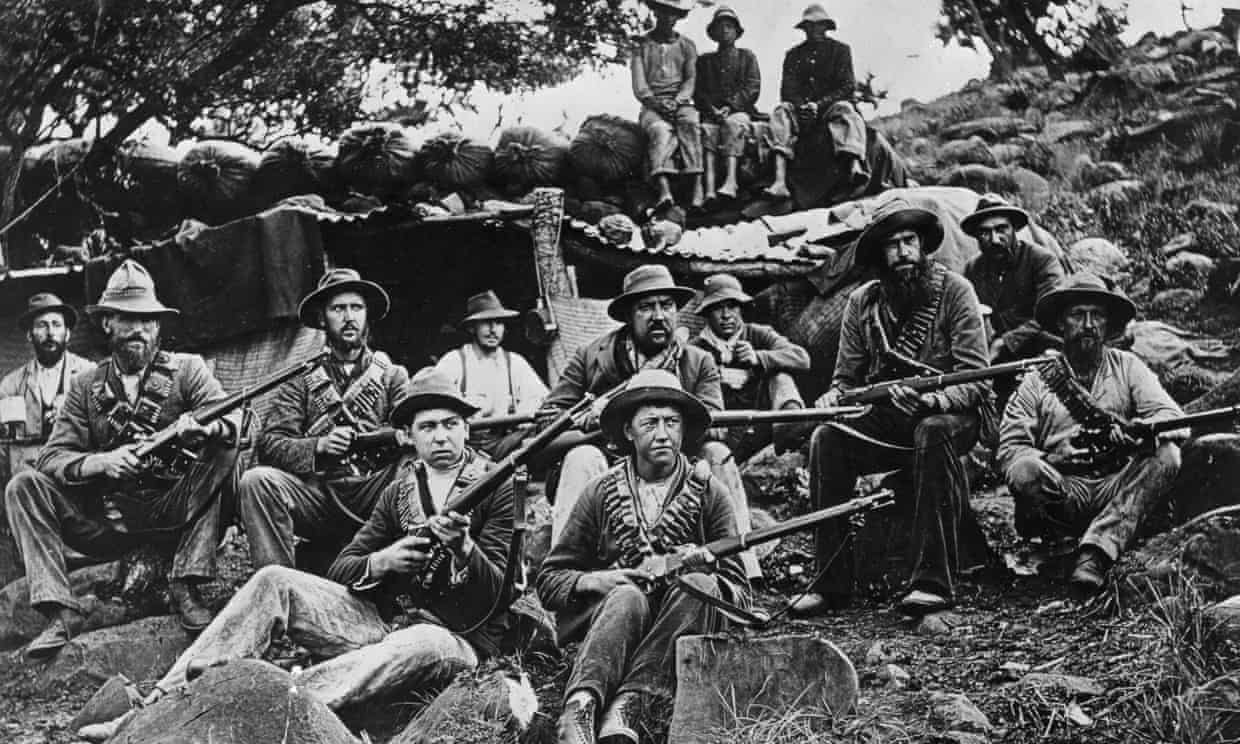

(Photo by the Imperial War Museums)

The Boer Wars, also called the Wars of Independence or the Anglo-Boer Wars, were two wars that took place in South Africa between 1880-1881 and 1899-1902. Both wars were fought primarily between the Boers (of mostly Dutch descent) and the British army. These events culminated in Boer nationalism, which eventually led to the instatement of apartheid.
History
Boers first began to settle in South Africa after Dutchman Jan van Riebeeck found Cape Town in 1653. The majority of the settlers were Dutch, but there was also a sizable amount of French and Germans who relocated to the southern tip of Africa. In 1806, Britain took the Dutch Cape colony, and many Boers (original European inhabitants of the Cape colony) resented Anglicization and anti-slavery policies which were instated by the British. About 15,000 people (called Voortrekkers) moved into the interior of South Africa.
The First Boer War
Resentment of new British policies and the marginalization of their people caused many Boers to move further into the interior of southern Africa. The appeal of the area was similar to America’s Wild West, since there was little government oversight and people could be more isolated from societal rules and bureaucracy. Here, the Boers set up the Transvaal and Orange Free States.

_(14758450296).jpg)
Once diamonds were found near the Vaal River, Britain set their sights on Boer territory. The British annexed the Transvaal in 1877, causing war to rage as Boers fought for independence. Almost the entire white population between the ages of 16 and 60 could be conscripted into action without pay. Boers utilized guerrilla warfare, which they had already had experience in as they fought and displaced the native Africans. The British who were not accustom to this type of fighting lost ground, and the Transvaal regained full independence in 1884.
The Second Boer War
Historically the more important of the two wars, the Second Boer War lasted from 1899-1902, and is often called the South African War because it more affected all of South Africa’s inhabitants than the first war did.

Like the first, the Second Boer War was fueled by minerals. Gold mines in the Transvaal began to make the republic rich, so Britain attempted to take the area in a failed coup in 1896. Afrikaner nationalism soared leading to fighting to break out in 1899. The British practiced scorched earth policies, which led to the destruction of Boer towns and 1000s of farms, and crops were burned while livestock were slaughtered.

https://theconversation.com/concentration-camps-in-the-south-african-war-here-are-the-real-facts-112006
Soon the British began to move Boer women and children to concentration camps to prevent them from supplying food and other resources to the Boer soldiers. Black Africans were also moved to these camps to be used as labor for the gold mines which were re-opened in 1901. Overall, 115,000 people were sent to these concentration camps, and 28,000 Boers and 20,000 Blacks died from poor food and medicine quality and unhygienic conditions.

(Photo from LSE Library)
.jpg)
The British took the Orange Free State and Transvaal in 1900 although fighting lasted for another two years.
South Africa After the Wars
By the end of the war, approximately 28,000 British and Boer soldiers were dead. The wars were the bloodiest and most expensive (£202 billion in 2014 prices) wars experienced for the British empire between 1815 and 1914. Many Boers and Blacks were left in poverty and unemployed resulting in a large migration to the cities where many found work in the gold mines.

(Photo from Library of Congress)
The provinces of the Transvaal, the Orange Free State, the Cape of Good Hope, and Natal were united in 1910 to form South Africa. In 1961, the Republic of South Africa gained independence from the British empire, but Black Africans would not be granted full rights for decades. Boer nationalism caused by the Boer Wars and a fear of the Black majority led to apartheid practices which persisted until 1994.

You May Also Like: The Bantu Migration: The Origin of Modern Southern Africa
Previous: Great Zimbabwe: A Look Into Africa’s Lost Past
Next: The Color TV
Leave a Reply