Last Update: Oct. 13, 2023


What Was the Rwandan Genocide?
The Rwandan Genocide was a period of about 100 days from April-July 1994 when 800,000 people lost their lives to ethnic conflict. Hutu extremists were the main perpetrators of the genocide. Their goal was to kill their political and ethnic rivals, the Tutsis.
Who Were the Hutus and Tutsis?
The Hutus and Tutsis are the main ethnic groups in Rwanda.
The Hutus are the larger group, making up about 85% of the total population. Traditionally, they are classified as Bantu farmers. Tutsis, on the other hand, count for about 14% of Rwanda’s population and have historically been called Ethiopian pastoralists. There is also a third ethnic group that comprises 1% of the population: the Twa, or Pigmy hunters.
Throughout history, the relationship between the Hutus and the Tutsis has been complicated. For a long time, the two groups lived with each other, and there wasn’t an issue. But, around 400-600 years ago, a group of Tutsis from Ethiopia attacked the Hutus, and although the Tutsis were outnumbered, they took over the Hutu. A Tutsi king then ruled the area that is now Rwanda and Burundi.
This invasion also led to a myth that goes something like this:
Kigwa, who fell from heaven, told his three sons, Gatwa, Gahutu, and Gatutsi, to watch over a pot of milk overnight. But, only Gatutsi kept watch, so he became Kigwa’s successor. And as Kigwa’s successor, he and his descendants were not to perform any menial tasks. Gahutu and his children, meanwhile, had to be Gatutsis’ servants, and Gatwa and his family were condemned to be hungry and poor.
What Caused the Hatred Between the Hutus and Tutsis?
Interestingly, the Tutsi invasion was not the primary catalyst for the ethnic hatred, or at least not what set it off. Of course, as with any two groups, especially when an invasion is involved, there was some animosity, but it wasn’t an overwhelming issue.
Instead, for centuries, the Hutu and Tutsi lived together, spoke the same language, and intermarried.
It wasn’t until Europeans, primarily Belgians, entered the mix that ethnic fighting really started to take off.
A common European colonial strategy was to pit two neighboring kingdoms/tribes/ethnic groups against each other. Overall, it was a ‘divide and conquer’ type of thing. The idea was that if you could make two groups fight with each other, it would weaken them both and divert their attention away from the colonists. Then, it would be easier for the colonists to take over and control them.
See, at one point, Rwanda and Burundi were one administrative area, called Ruanda-Urundi. Ruanda-Urundi was initially a German possession, but the League of Nations (the original UN) awarded the land to Belgium in 1916. And pretty quickly, the Belgians began to stoke the flames between the Hutus and Tutsis.
The Belgians supported the myth that Gatutsi and his descendants were above the Hutu majority. And the Belgians really believed the Tutsis were superior because the Europeans thought that the Tutsis looked more like Eurasians. Thus, of course, the Belgians claimed that the Tutsis were smarter, more beautiful, and more refined (because, of course, they did – racism is a hell of a drug).
So, because of these ideas, the Belgians made everyone carry cards that stated their ethnicity, and only Tutsis were allowed to hold positions of power and get an education. This treatment only made the split between the two groups more severe.
Then, in 1962, Ruanda-Urundi gained independence and split into two countries: Rwanda and Burundi. And in Rwanda, the Hutu majority took control of the country. They then immediately killed thousands of Tutsis, causing hundreds more to cross the border into Uganda.
What Caused the Genocide in 1994?
Ethnic fighting and all of the reasons above caused the Rwandan Genocide. But why did everything get so bad in the Spring of 1994?
Well, part of the reason had to do with a rapidly declining economy. And, as history tells us, when people’s standard of living decreases, social unrest often follows.
You see, after independence in the 60s and 70s, Rwanda went through a period of prosperity. But, during the 1980s, several emergencies quickly weakened the country. The main reason for this economic crash, though, was the disruption in the price of coffee, Rwanda’s number one export.
At one point in time, coffee prices among the major exporting and importing countries were controlled by the International Coffee Agreement (ICA). The ICA kept coffee prices stable between $1 and $1.50 USD per pound. However, in 1989, partly because of a strong belief in free-market ideals, the Raegan Administration pulled the USA out of the ICA, leading to its collapse.
Once the ICA fell apart, coffee prices fell to about $0.49 USD per pound. In Rwanda, this depletion of value was devastating. An economic crisis soon set in, leading to a lack of resources and dependency on foreign aid. A drought in the area also didn’t help.
Hundreds of thousands of Rwandan households saw their incomes cut in half very quickly, and by just 1990, 85% of the population were living below the poverty line.
So, you can see how in this climate, people would begin to panic, and many would look for someone to blame for their misfortunes. Enter the RPF.
The Rwandan Patriotic Front, more commonly abbreviated to RPF, was a group of Tutsis who had been living outside of Rwanda since the 1960s, and in October 1990, they saw their chance to strike back at the people who had forced them from their homes. The RPF invaded northeastern Rwanda, kicking off the Rwandan Civil War.
But, at the beginning of the war, most people did not want the violence to escalate any further. Instead, there were protests where citizens asked President Juvénal Habyarimana to make peace with the RPF to end the fighting.
Yet, Habyarimana, who had been president since 1973 and had basically become a dictator, was afraid that the international attention that Rwanda was getting would put pressure on him to step down as ruler. And this belief was not unfounded. One of the main things that the RPF wanted was democracy in Rwanda, and democratic global powers often put pressure on dictatorial countries to become democracies.
So, in his fear, Habyarimana began to paint the RPF, and as an extension, all Tutsis, as blood-thirsty and greedy, claiming they only wanted to steal land from the Hutus. These claims from the president, along with the Hutu extremist radio station, Radio-Television Libre de Mille Collines, created fear and turned many Hutus against the Tutsis.
Then, finally, came the Arusha Accords, where The Organization of African Unity met with Habyarimana to discuss peace between the warring groups. However, on his way home on April 6th, 1994, Habyarimana’s plane was shot down, leading to his death. The culprits are still unknown, but many Hutus blamed the RPF for the crash.
Now, the genocide would commence.
What Happened During the Rwandan Genocide?
Warning: Many of the below descriptions are very graphic.
On the day after the plane crash that killed Habyarimana and Burundi President Cyprien Ntarymira, Hutu extremists stormed the compound of Rwandan Prime Minister Agathe Uwilingiyimana and killed her. The Hutu extremists then set up their own government on April 9th, 1994.
But, even before the new government was set up, the genocide was already in full swing.
Immediately after Habyarimana’s death, Hutu extremists began to murder Tutsis. Federal and local leaders told Rwandan civilians to arm themselves and to kill any Tutsi they could find, including infants. And many Hutus willingly went out to kill their fellow citizens, usually with machetes. However, there were also many Hutus who were opposed to the murders. But, to ensure as many Tutsis as possible died, any Hutu who refused to kill was threatened with death, maiming, or rape. Thus, many Hutus conceded and joined in the murder.


And murder wasn’t the only means to torture Tutsis. Lots of Tutsi women were also raped. In fact, the government set up rape squads, which primarily consisted of Hutus who were HIV positive. The idea was to cause a slow, painful death. Also, many Tutsi men and women had their genitals mutilated, often in public.
For the most part, murders were committed differently in the cities and the countryside. In urban areas, the army committed most of the killings. They would set up roadblocks or go door-to-door and ask for people’s citizenship cards, which listed their ethnicity. Anyone who had’ Tutsi’ on their card or refused to show a card was killed.
In the rural areas, though, the rapes and murders were usually performed by civilians. And a lot of the people who participated in these attacks even killed their Tutsi friends and neighbors, either because they believed they were a threat to them or because others forced them to do so.
Plus, in addition to the murders of Tutsis and Hutu moderates, about one-third of the Twa population was killed because of a belief they were conspiring with the RPF.
Many of these bodies were then dumped into the Kagera River, which runs between Rwanda and Uganda. Uganda quickly began to pull bodies from the river because of fear that the corpses would disrupt Uganda’s fishing economy.
Overall, between 500,000 and 1,000,000 people were killed during the Spring of 1994, 94% of whom were Tutsis. Also, about two million Rwandans fled over the border to Zaire. The killings and displacement left Rwanda in shambles.
How Did the Rwandan Genocide End?
The Rwandan Genocide ended in July of 1994. In just a few short months, the RPF, who had earlier been run out of the country, went prefecture by prefecture until they had completely taken over and ended the killings of the Tutsis. But, the RPF did not stop all the killings, and the Tutsis murdered about 30,000 people in retribution.
Yet, the new government of Rwanda was set up with a Hutu as president and a Tutsi as Vice President.
The Aftermath of the Rwandan Genocide
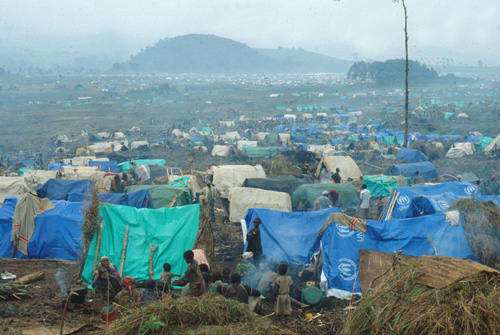
Rwanda, of course, did not recover easily from the genocide. Instead, many Hutus and previous Hutu leaders ended up in UN refugee camps in Zaire (now called the Democratic Republic of the Congo). From here, they launched attacks on Rwanda, hoping to take back the country.
However, the Hutus were not successful in their attempts, and the RPF pursued many of them into Zaire, where they killed about 232,000 Hutu refugees. And, because the leader of Zaire, Mobutu Sese Seko, supported the Hutus, Rwanda and Uganda assisted a rebel group in Zaire, leading to the First Congo War in 1996.
Additionally, thousands of Hutus died in the squalid refugee camps, primarily from diseases like cholera and dysentery.


But the news isn’t all bleak.
Today, Rwanda’s political structure has been relatively stable, and the economy is growing, primarily because of agriculture and tourists who want to see the country’s wild gorillas.
Other promising statistics include:
- Life expectancy has risen from 29 in 1995 to 69 in 2019
- Virtually all children are enrolled in primary school
- In 2019, the fertility rate was 3.99 children per woman, compared to 4.64 children per woman just ten years earlier.
- The GDP has risen from $1.2 billion USD in 1994 to $10.36 billion in 2019.


What Did the UN Do During the Rwandan Genocide?
The United Nations has been heavily criticized for its failures during the Rwandan genocide.
Although UN peacekeeping forces were present in Rwanda before and during the genocide, they were told by the commander of the United Nations Assistance Missions for Rwanda (UNAMIR) not to shoot unless someone shot at them. And since Hutu extremists often had no reason to attack UN troops, they did almost nothing to stop the genocide.
The UN’s lack of response in Rwanda was mainly due to three reasons.
UN troops have historically been hesitant to use force for fear that they will escalate the issue.
Like the failures in Bosnia around the same time, UN policymakers were ill-informed and had little troops and resources to make an effect.
The United States government and populace were afraid of a repeat of the Battle of Mogadishu in October 1993. Here, an American Task Force attempted to seize two important militiamen in Somalia. However, the operation turned into a battle in the streets, which led to several American deaths.
Leave a Reply